
In Galicia, trails beyond the Camino de Santiago are, for the most part, abandoned. This reflects a broader pattern of neglect — almost an ostentatious one — that is difficult to find elsewhere in Europe. An aging population and the lack of generational renewal should be fueling a widespread demand for change, yet the prevailing impression is one of stagnation and immobility.
And still, government is everywhere. Not in maintaining essentials, but in financing small, largely inconsequential restoration projects and sporadic economic initiatives. Nearly every business seems to receive some form of subsidy. During Covid, policymakers decided to support the renovation of rural homes, triggering a veritable boom. The predictable outcome was an excess of supply disconnected from actual demand. As the Soviet Union should have taught us, planned economies do not work. Everything is funded except what truly matters. Basic infrastructure is often in a pitiful state, and what is missing above all is a coherent vision capable of creating the conditions for private initiative to generate sustainable development.
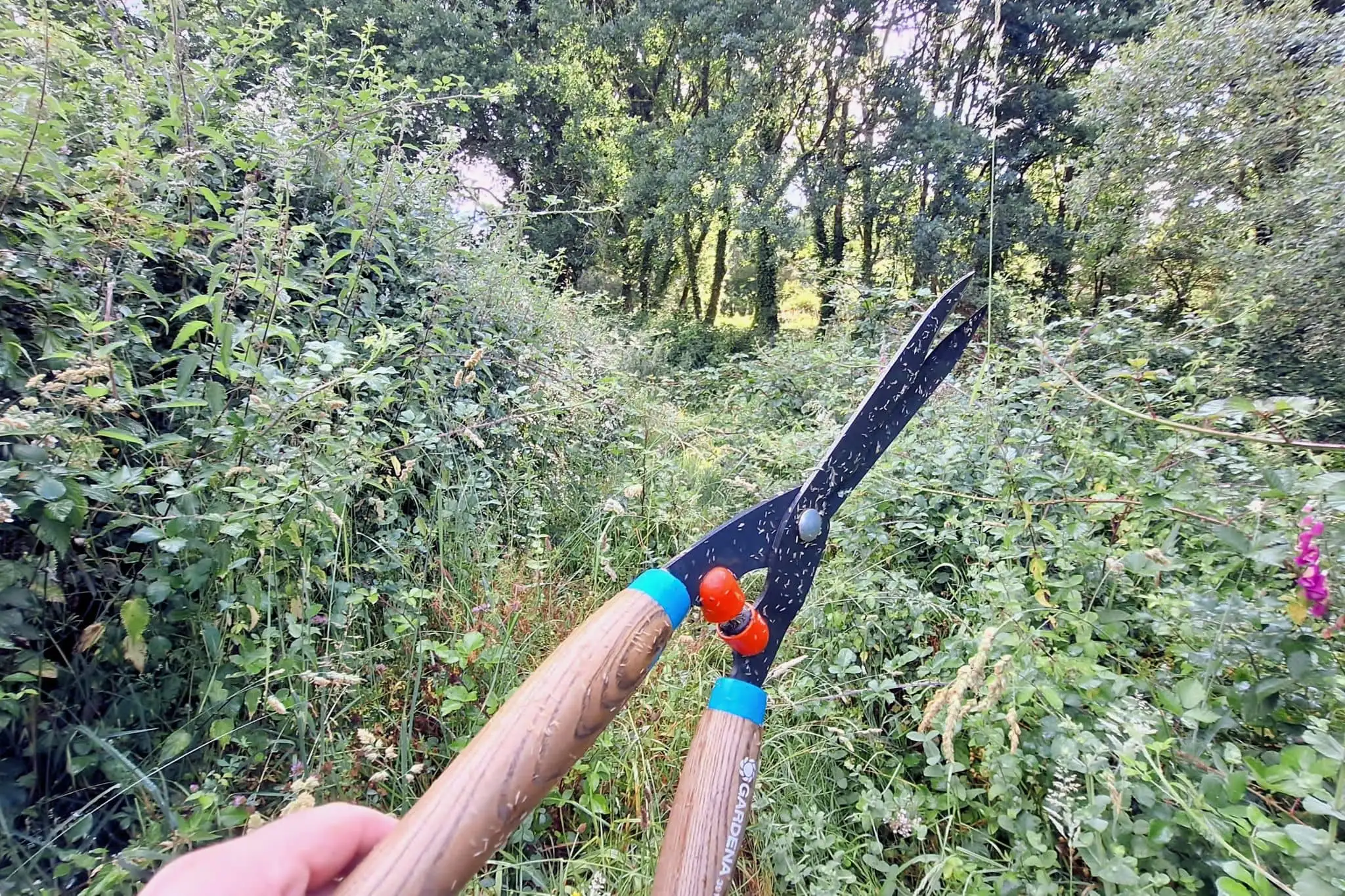
The one positive aspect of this situation is that, at the aldea level, a kind of spontaneous anarchic order emerges out of necessity. I hadn’t walked the path from my house to the Miño River for months — not because I had lost interest in it, but because it had become impassable. Brambles and nettles over a meter and a half high had swallowed the trail. The local community had promised to clear it, but most residents are elderly, and the younger ones spend far more time on tractors than walking through the countryside.
The solution? Pick up a pair of pruning shears and get to work.
When you realize that you can change things yourself — without asking permission and without expecting gratitude — something clicks. A spark ignites. Suddenly, the question is no longer whether something should be done, but what to tackle next. This is not guerrilla warfare; it is simply taking responsibility for the territory that sustains you. For anyone accustomed to the ready-made comforts of urban life, it feels like a precious gift.
If this is the future, however, the underlying social contract will have to evolve. Our very understanding of what is “public,” and of how public goods are governed and financed, may need to be fundamentally reconsidered. Who knows? Perhaps Galicia itself will become a testing ground for that experiment.
The pruning shears are the strongest thing here — concrete, slightly absurd, earned. The piece works when it stays at trail level, where you can actually see the gap between the subsidy and the brambles. Where it gets shakier is the part you’d probably defend hardest: the Soviet line. Galicia’s problem isn’t central planning in the Gosplan sense. It’s the opposite — a swarm of small, uncoordinated disbursements, EU structural funds and regional grants scattered like birdseed, each individually rational and collectively pointless. That’s not the failure of the plan; it’s the failure of no plan, money without a spine. Invoking the USSR actually lets the Xunta off the hook, because it implies someone was at least trying to direct things. Nobody was. That’s worse, and more interesting.
And here’s the tension you wave at but don’t grab: your spontaneous anarchic order and your call for a renewed social contract are pulling in opposite directions. If picking up the shears yourself is the precious gift, then the last thing you want is a coherent vision creating conditions for development — that’s just the subsidy machine with better taste. You can have the anarchic aldea or the visionary state. The essay wants both, and the seam shows.
There’s also a quieter assumption worth poking: that demographic decline should fuel demand for change. Why would it? Aging populations optimize for stability, not dynamism. The immobility isn’t a malfunction of the system — it’s the system working exactly as its median voter wants. Stagnation is a preference, not an accident.
The closing “who knows?” undersells you. You’ve just spent four paragraphs arguing that the future is people governing the territory that sustains them, permissionless. That’s not a question mark. Galicia isn’t going to become a testing ground — you turned it into one the moment you cut the trail. Say that.
Leave a Reply